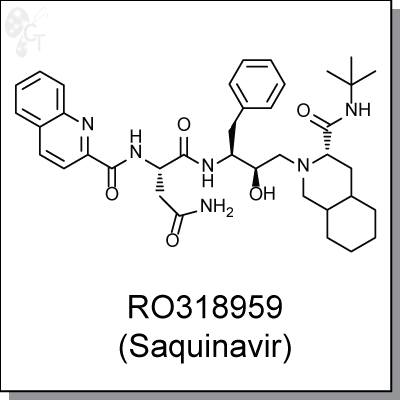
RO318959 (Saquinavir) | HIV-1 protease inhibitorCellagen TechnologyPrice from $159.00 to $1,431.00.
Cellagen Technology
HIV-1 entry blocker
Plerixafor (AMD3100) is a bis-tetraazadecane-based, selective inhibitor of human immunodeficiency virus. It is inhibitory to the replication of various HIV-1 and HIV-2 strains in various cell lines at an EC50 of 1-10 ng/mL, about 100,000-fold lower than cytotoxic concentrations (>500 uM/mL). [1] Plerixafor shows inhibition to HIV-1(IIIB) and several clinical HIV-1 isolates at an EC50 of less than 1 ng/mL.
Plerixafor has been shown to be active in HIV strains resistant to reverse transcriptase inhibitors AZT, DDI, 3TC, aAPA, and TIBO. [2]
Plerixafor blocks HIV-1 entry and membrane fusion via the CXCR4 co-receptor, but not via CCR5. It also prevents monoclonal antibody 12G5 from binding to CXCR4. Entry into CXCR-expressing cells was strongly inhibited by Plerixafor at IC50 values of 0.01-0.1 nM. [3] Plerixafor demonstrates a specific antagonism of the interaction between chemokine SDF-1 and CXCR4, reducing severity of inflammation in CIA models. [4]



Cellagen Technology
HIV-1 entry blocker
Plerixafor (AMD3100) is a bis-tetraazadecane-based, selective inhibitor of human immunodeficiency virus. It is inhibitory to the replication of various HIV-1 and HIV-2 strains in various cell lines at an EC50 of 1-10 ng/mL, about 100,000-fold lower than cytotoxic concentrations (>500 uM/mL). [1] Plerixafor shows inhibition to HIV-1(IIIB) and several clinical HIV-1 isolates at an EC50 of less than 1 ng/mL.
Plerixafor has been shown to be active in HIV strains resistant to reverse transcriptase inhibitors AZT, DDI, 3TC, aAPA, and TIBO. [2]
Plerixafor blocks HIV-1 entry and membrane fusion via the CXCR4 co-receptor, but not via CCR5. It also prevents monoclonal antibody 12G5 from binding to CXCR4. Entry into CXCR-expressing cells was strongly inhibited by Plerixafor at IC50 values of 0.01-0.1 nM. [3] Plerixafor demonstrates a specific antagonism of the interaction between chemokine SDF-1 and CXCR4, reducing severity of inflammation in CIA models. [4]