Cyclopamine | Hedgehog pathway inhibitorCellagen TechnologyPrice from $129.00 to $1,161.00.
Cellagen Technology
Hedgehog pathway inhibitor
GDC-0449 (Vismodegib) is a potent, orally bioavailable, specific hedgehog pathway small-molecule inhibitor with IC50 of 3 nM. It blocks the activities of the Hedgehog-ligand cell surface receptor SMO and suppresses Hedgehog signaling [1].
The hedgehog (HH) pathway, a key signaling pathway in embryological development, is normally inactive in differentiated cells, with the exception of roles in tissue maintenance and repair. Constitutive reactivation of the HH pathway via mutations and aberrant autocrine/paracrine HH ligand stimulation has been linked to a number of cancers5. GDC-0449 has been shown to target SMO with an EC50 of 2.8nmol/L on a human palatal mesenchymal cell line (HEPM) stably expressing a GLI-responsive luciferase reporter gene, and to induce rapid regression of the tumor and suppression of the hedgehog pathway in the Ptc1+/? murine medulloblastoma model. Furthermore, GDC-0449 inhibits the growth of primary pancreatic xenografts without non-specifically inhibiting pancreatic cell proliferation in vitro [1-3]. GDC-0449 is also an inhibitor of two multiple ATP-binding cassette (ABC) transporters, ABCG2/BCRP and ABCB1/Pgp, and is a mild inhibitor of ABCC1/MRP1. The overexpression of ABC transporters is associated with multidrug resistance. The IC50 values for inhibition of ABCG2 and Pgp were approximately 1.4 and 3.0 µM, respectively [4].

Cellagen Technology
Hedgehog pathway inhibitor
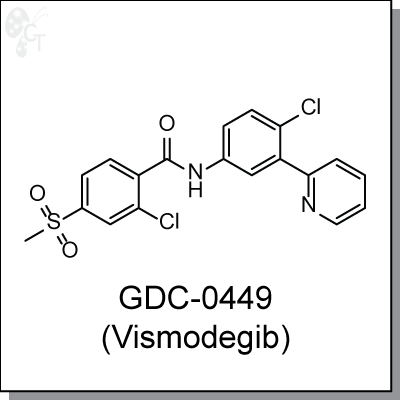
GDC-0449 (Vismodegib) is a potent, orally bioavailable, specific hedgehog pathway small-molecule inhibitor with IC50 of 3 nM. It blocks the activities of the Hedgehog-ligand cell surface receptor SMO and suppresses Hedgehog signaling [1].
The hedgehog (HH) pathway, a key signaling pathway in embryological development, is normally inactive in differentiated cells, with the exception of roles in tissue maintenance and repair. Constitutive reactivation of the HH pathway via mutations and aberrant autocrine/paracrine HH ligand stimulation has been linked to a number of cancers5. GDC-0449 has been shown to target SMO with an EC50 of 2.8nmol/L on a human palatal mesenchymal cell line (HEPM) stably expressing a GLI-responsive luciferase reporter gene, and to induce rapid regression of the tumor and suppression of the hedgehog pathway in the Ptc1+/? murine medulloblastoma model. Furthermore, GDC-0449 inhibits the growth of primary pancreatic xenografts without non-specifically inhibiting pancreatic cell proliferation in vitro [1-3]. GDC-0449 is also an inhibitor of two multiple ATP-binding cassette (ABC) transporters, ABCG2/BCRP and ABCB1/Pgp, and is a mild inhibitor of ABCC1/MRP1. The overexpression of ABC transporters is associated with multidrug resistance. The IC50 values for inhibition of ABCG2 and Pgp were approximately 1.4 and 3.0 µM, respectively [4].