S3I-201 (NSC74859) | Stat3 activity inhibitorCellagen TechnologyPrice from $79.00 to $632.00.
Cellagen Technology
PARP inhibitor
BSI-201 (Iniparib), a iodonitrobenzamide-based cytotoxic agent, was initially considered to be a PARP inhibitor based on its abillity to inactivate PARP by means of zinc ejection from the zinc finger of the enzyme. [1]
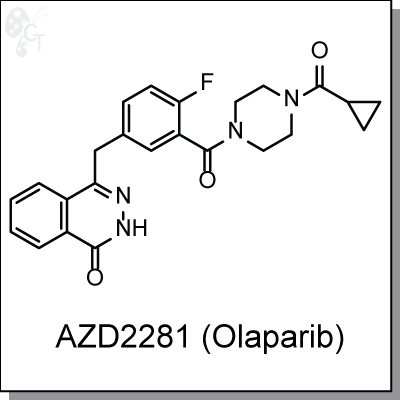
Despite its ability to kill normal and neoplastic cells at high concentrations (>40 uM), further studies revealed that BSI-201 did not selectivly kill homologous-recombination (HR)-deficient cells, sensitize cells to topoisomerase I poisons, or inhibit PARP in situ, as seen with olaparib and veliparib. [2]
Through a battery of enzymatic, cellular, and viability assays, BSI-201 was shown to nonselectively modify cysteine-containing proteins in tumor cells. It is also postulated that the formation of nonspecific adducts can alter stability, activity, and localization, thus inducing apoptosis, stress, cell-cycle perturbation, or DNA damage. [3]


Cellagen Technology
PARP inhibitor
BSI-201 (Iniparib), a iodonitrobenzamide-based cytotoxic agent, was initially considered to be a PARP inhibitor based on its abillity to inactivate PARP by means of zinc ejection from the zinc finger of the enzyme. [1]
Despite its ability to kill normal and neoplastic cells at high concentrations (>40 uM), further studies revealed that BSI-201 did not selectivly kill homologous-recombination (HR)-deficient cells, sensitize cells to topoisomerase I poisons, or inhibit PARP in situ, as seen with olaparib and veliparib. [2]
Through a battery of enzymatic, cellular, and viability assays, BSI-201 was shown to nonselectively modify cysteine-containing proteins in tumor cells. It is also postulated that the formation of nonspecific adducts can alter stability, activity, and localization, thus inducing apoptosis, stress, cell-cycle perturbation, or DNA damage. [3]