Loading...
Loading...
Loading...
Loading...
Cellagen Technology
HDAC inhibitor
Trichostatin A (TSA) is a potent histone deacetylase (HDAC) inhibitor. It inhibits HDAC 1, 2, 3, 6, 10, 11 at IC50s of less than 10 nM, with over 300-fold selectivity against class IIa HDACs.[1] TSA affects DNA replication and gene expression by inhibiting HDAC activity and therefore altering the histone modifications and access of DNA inside chromatin.
Trichostatin A induces apoptosis and cell growth arrest at both G and G/M phases. As HDACs are overexpressed in many cancer types, TSA is widely used to probe the tumorigenesis mechanism targeting HDAC.[2] Trichostatin A was found to prevent the differentiation of embryonic stem cell,[3] while TSA treatment increased functional characteristics of human ESC/iPSC-derived cardiomyocytes.[4]

Cellagen Technology
HDAC inhibitor
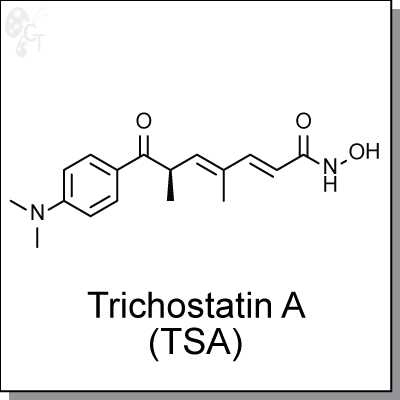
Trichostatin A (TSA) is a potent histone deacetylase (HDAC) inhibitor. It inhibits HDAC 1, 2, 3, 6, 10, 11 at IC50s of less than 10 nM, with over 300-fold selectivity against class IIa HDACs.[1] TSA affects DNA replication and gene expression by inhibiting HDAC activity and therefore altering the histone modifications and access of DNA inside chromatin.
Trichostatin A induces apoptosis and cell growth arrest at both G and G/M phases. As HDACs are overexpressed in many cancer types, TSA is widely used to probe the tumorigenesis mechanism targeting HDAC.[2] Trichostatin A was found to prevent the differentiation of embryonic stem cell,[3] while TSA treatment increased functional characteristics of human ESC/iPSC-derived cardiomyocytes.[4]