Loading...
Loading...
Loading...
Loading...
Vazyme

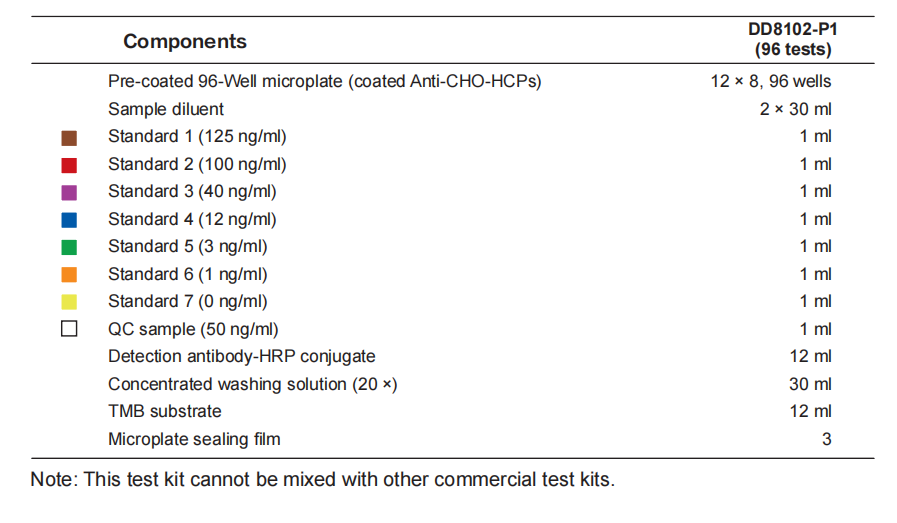
This kit employs a fed-batch culture process using CHO to immunize goats for the production of HCP-specific antibodies. The kit is based on a double-antibody sandwich enzyme-linked immunosorbent assay (ELISA) to detect residual CHO-HCPs in biologics process samples. The wells of the ELISA plates are pre-coated with Anti-CHO-HCPs goat polyclonal antibodies. CHO-HCPs calibrators and test samples are added to the solid-phase antibody-coated wells, followed by the addition of the detection antibodies-HRP conjugate. Through a one-step incubation, any residual CHO-HCPs present in the test samples are captured by the solid-phase antibodies and simultaneously detected by the detection antibodies, forming a "coated antibody-(CHO-HCPs antigen)-detection antibodies-HRP conjugate" complex. Unbound substances are removed by washing, and TMB substrate is added for color development. The reaction is then stopped, and the absorbance is measured at dual wavelengths of 450 nm and 630 nm. The absorbance of the samples is positively correlated with the residual amount of CHO-HCPs in the process samples. The concentration of CHO HCPs in the samples can be calculated using a dose-response curve.

Vazyme
This kit employs a fed-batch culture process using CHO to immunize goats for the production of HCP-specific antibodies. The kit is based on a double-antibody sandwich enzyme-linked immunosorbent assay (ELISA) to detect residual CHO-HCPs in biologics process samples. The wells of the ELISA plates are pre-coated with Anti-CHO-HCPs goat polyclonal antibodies. CHO-HCPs calibrators and test samples are added to the solid-phase antibody-coated wells, followed by the addition of the detection antibodies-HRP conjugate. Through a one-step incubation, any residual CHO-HCPs present in the test samples are captured by the solid-phase antibodies and simultaneously detected by the detection antibodies, forming a "coated antibody-(CHO-HCPs antigen)-detection antibodies-HRP conjugate" complex. Unbound substances are removed by washing, and TMB substrate is added for color development. The reaction is then stopped, and the absorbance is measured at dual wavelengths of 450 nm and 630 nm. The absorbance of the samples is positively correlated with the residual amount of CHO-HCPs in the process samples. The concentration of CHO HCPs in the samples can be calculated using a dose-response curve.