Loading...
Loading...
Loading...
Loading...
Cellagen Technology
Proteasome inhibitor
Bortezomib is a first-in-class dipeptide boronic acid-based, water-soluble proteasome inhibitor. As a single agent, bortezomib was found to have consistent antitumor activity in both chemosensitive and chemoresistant multiple myeloma cells at an IC50 of 10-20 ng/mL. [1] Bortezomib overcomes the resistance to apoptosis in multiple myeloma cells that is induced by IL-6. [2] Additionally, bortezomib prevents TNF-a-induced, NF-kB-dependent upregulation of IL-6 and reduces cell adhesion; proliferation of remaining adherent multiple myeloma cells was also inhibited by bortezomib. [1]
In MM cell lines U266, IM-9, and Hs Sultan, bortezomib inhibited at IC50 concentrations of 3, 6, and 20 nM, respectively. [2] Cell growth of Dox40, MR20, and LR5 MM cells was completely inhibited by bortezomib at 100 nM IC50.
Bortezomib suppresses growth and induces apoptosis in Bcr/Abl-positive cells sensitive and resistant to IM. Interestingly, sequential combination of bortezomib followed by imatinib resulted in a synergistic pro-apoptotic effect in imatinib-resistant cells; simultaneous exposure of bortezomib and imatinib was antagonistic. [3]
Cellagen Technology
Proteasome inhibitor
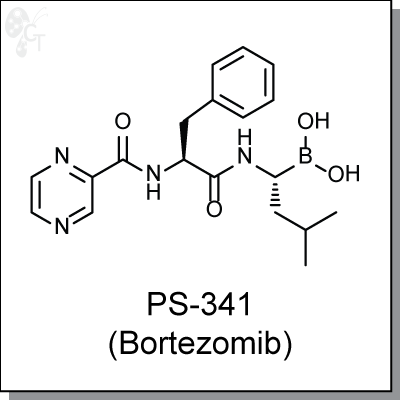
Bortezomib is a first-in-class dipeptide boronic acid-based, water-soluble proteasome inhibitor. As a single agent, bortezomib was found to have consistent antitumor activity in both chemosensitive and chemoresistant multiple myeloma cells at an IC50 of 10-20 ng/mL. [1] Bortezomib overcomes the resistance to apoptosis in multiple myeloma cells that is induced by IL-6. [2] Additionally, bortezomib prevents TNF-a-induced, NF-kB-dependent upregulation of IL-6 and reduces cell adhesion; proliferation of remaining adherent multiple myeloma cells was also inhibited by bortezomib. [1]
In MM cell lines U266, IM-9, and Hs Sultan, bortezomib inhibited at IC50 concentrations of 3, 6, and 20 nM, respectively. [2] Cell growth of Dox40, MR20, and LR5 MM cells was completely inhibited by bortezomib at 100 nM IC50.
Bortezomib suppresses growth and induces apoptosis in Bcr/Abl-positive cells sensitive and resistant to IM. Interestingly, sequential combination of bortezomib followed by imatinib resulted in a synergistic pro-apoptotic effect in imatinib-resistant cells; simultaneous exposure of bortezomib and imatinib was antagonistic. [3]